Bulk fermentation & sourdough temperature chart
How long sourdough takes at every temperature from 60 to 90°F: starter peak, bulk fermentation and final proof, as estimated ranges. Tap a temperature for the full guide, or get today's numbers for your kitchen.
Sourdough proofing time chart by temperature
Estimated ranges (±20%) for a healthy starter and a dough at about 75% hydration. Bulk is to a 50–75% rise. Starter strength varies, so watch the dough, not the clock.
| Temp | Starter peak 1:1:1 | Starter peak 1:2:2 | Bulk ferment 20% levain | Final proof room temp |
|---|---|---|---|---|
| 60°F / 16°C | 6½–9¾ h | 8–11¾ h | 7¾–11½ h | 3–4½ h |
| 61°F / 16°C | 6¼–9½ h | 7½–11¼ h | 7¼–11 h | 3–4½ h |
| 62°F / 17°C | 6–9 h | 7¼–10¾ h | 7–10½ h | 2¾–4¼ h |
| 63°F / 17°C | 5¾–8¾ h | 7–10½ h | 6¾–10 h | 2¾–4 h |
| 64°F / 18°C | 5½–8¼ h | 6¾–10 h | 6½–9¾ h | 2½–4 h |
| 65°F / 18°C | 5¼–8 h | 6¼–9½ h | 6¼–9¼ h | 2½–3¾ h |
| 66°F / 19°C | 5–7½ h | 6–9¼ h | 6–9 h | 2¼–3½ h |
| 67°F / 19°C | 4¾–7¼ h | 5¾–8¾ h | 5¾–8½ h | 2¼–3½ h |
| 68°F / 20°C | 4¾–7 h | 5½–8½ h | 5½–8¼ h | 2¼–3¼ h |
| 69°F / 21°C | 4½–6¾ h | 5¼–8 h | 5¼–7¾ h | 2–3¼ h |
| 70°F / 21°C | 4¼–6½ h | 5¼–7¾ h | 5–7½ h | 2–3 h |
| 71°F / 22°C | 4–6¼ h | 5–7½ h | 4¾–7¼ h | 2–2¾ h |
| 72°F / 22°C | 4–6 h | 4¾–7 h | 4½–7 h | 1¾–2¾ h |
| 73°F / 23°C | 3¾–5¾ h | 4½–6¾ h | 4½–6½ h | 1¾–2¾ h |
| 74°F / 23°C | 3½–5½ h | 4¼–6½ h | 4¼–6¼ h | 1¾–2½ h |
| 75°F / 24°C | 3½–5¼ h | 4¼–6¼ h | 4–6 h | 1½–2½ h |
| 76°F / 24°C | 3¼–5 h | 4–6 h | 3¾–5¾ h | 1½–2¼ h |
| 77°F / 25°C | 3¼–4¾ h | 3¾–5¾ h | 3¾–5½ h | 1½–2¼ h |
| 78°F / 26°C | 3–4½ h | 3¾–5½ h | 3½–5¼ h | 1½–2¼ h |
| 79°F / 26°C | 3–4¼ h | 3½–5¼ h | 3½–5 h | 1¼–2 h |
| 80°F / 27°C | 2¾–4¼ h | 3¼–5 h | 3¼–5 h | 1¼–2 h |
| 81°F / 27°C | 2¾–4 h | 3¼–4¾ h | 3–4¾ h | 1¼–1¾ h |
| 82°F / 28°C | 2½–3¾ h | 3–4½ h | 3–4½ h | 1¼–1¾ h |
| 83°F / 28°C | 2½–3¾ h | 3–4½ h | 2¾–4¼ h | 1¼–1¾ h |
| 84°F / 29°C | 2½–3½ h | 2¾–4¼ h | 2¾–4 h | 1–1¾ h |
| 85°F / 29°C | 2½–3½ h | 2¾–4 h | 2¾–4 h | 1–1½ h |
| 86°F / 30°C | 2½–3½ h | 2½–4 h | 2½–3¾ h | 1–1½ h |
| 87°F / 31°C | 2½–3½ h | 2½–3¾ h | 2½–3½ h | 1–1½ h |
| 88°F / 31°C | 2½–3½ h | 2½–3½ h | 2¼–3½ h | 1–1½ h |
| 89°F / 32°C | 2½–3½ h | 2½–3½ h | 2¼–3¼ h | 1–1¼ h |
| 90°F / 32°C | 2½–3½ h | 2½–3½ h | 2–3¼ h | ¾–1¼ h |
The chart at a glance
Fermentation roughly halves in time for every 16°F (9°C) warmer. Save or pin the printable chart image.
- Bulk fermentation, 20% levain (±20% shaded)
- Starter peak, 1:2:2 feed
- Starter peak, 1:1:1 feed
- Final proof at room temperature
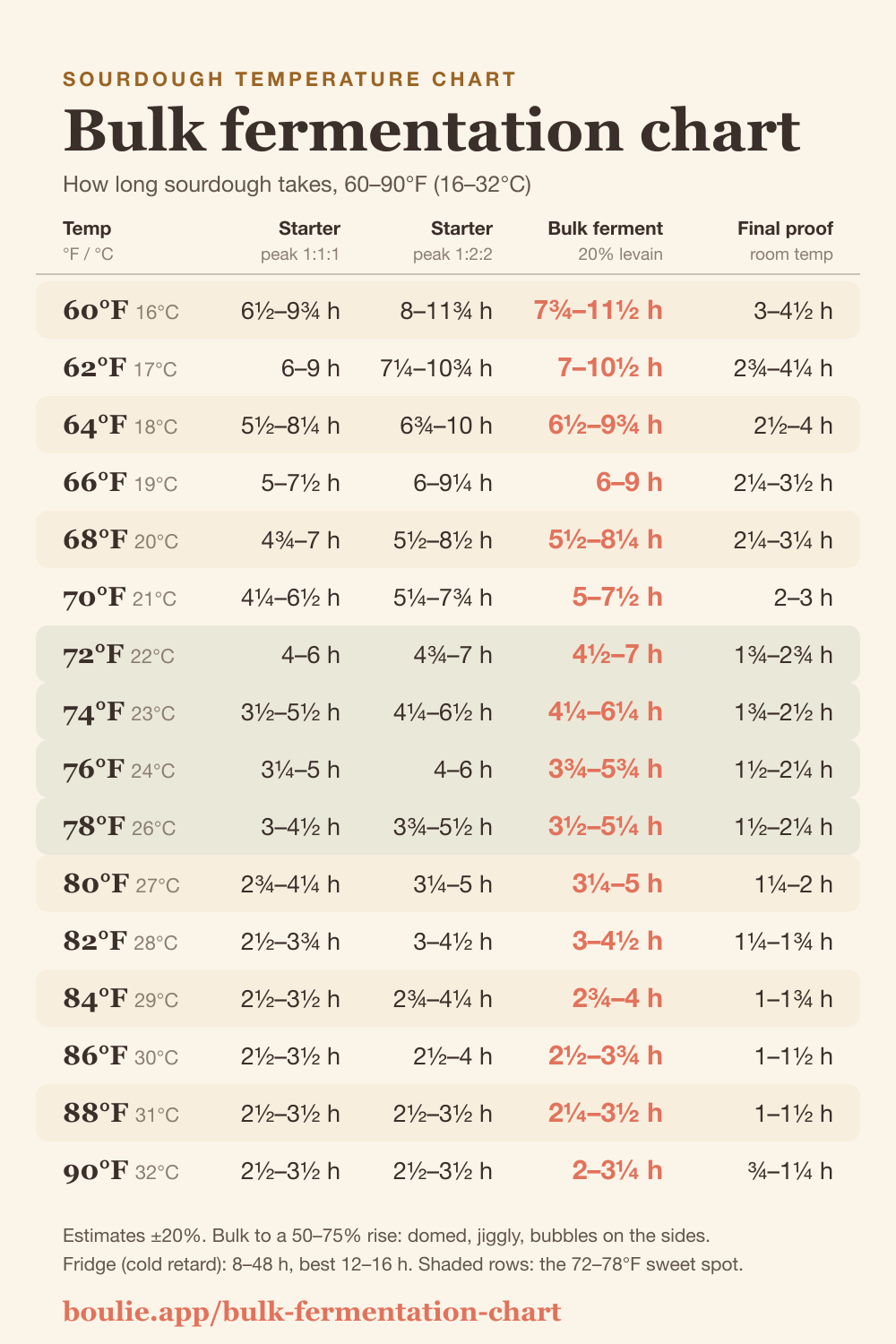 Printable chart image (save or pin it)
Bulk fermentation temperature chart by levain %
Bulk fermentation (the first rise after mixing) depends on temperature and on how much levain or starter you use, as a percentage of the flour. Less levain is slower; more is faster.
| Dough temp | 10% levain | 15% | 20% | 30% |
|---|---|---|---|---|
| 64°F / 18°C | 8¾–13 h | 7½–11¼ h | 6½–9¾ h | 5¼–7¾ h |
| 66°F / 19°C | 8–12 h | 6¾–10¼ h | 6–9 h | 4¾–7 h |
| 68°F / 20°C | 7¼–11 h | 6¼–9½ h | 5½–8¼ h | 4¼–6½ h |
| 70°F / 21°C | 6¾–10 h | 5¾–8½ h | 5–7½ h | 4–6 h |
| 72°F / 22°C | 6¼–9¼ h | 5¼–8 h | 4½–7 h | 3¾–5½ h |
| 74°F / 23°C | 5¾–8½ h | 4¾–7¼ h | 4¼–6¼ h | 3¼–5 h |
| 76°F / 24°C | 5¼–7¾ h | 4½–6¾ h | 3¾–5¾ h | 3–4¾ h |
| 78°F / 26°C | 4¾–7¼ h | 4–6 h | 3½–5¼ h | 2¾–4¼ h |
| 80°F / 27°C | 4½–6½ h | 3¾–5½ h | 3¼–5 h | 2½–4 h |
| 82°F / 28°C | 4–6 h | 3½–5¼ h | 3–4½ h | 2½–3½ h |
| 85°F / 29°C | 3½–5¼ h | 3–4½ h | 2¾–4 h | 2–3¼ h |
Whole wheat and rye ferment faster
The chart assumes mostly white flour. Bran and rye bring extra food and enzymes, so whole-grain doughs move faster. Rough estimate, not part of the model: with 30% or more whole wheat, plan on the low end of the range for your temperature and start checking early. Mostly-rye doughs can be quicker still and never dome like wheat; look for cracks and holes on the surface rather than a big rise.
How to tell bulk fermentation is done
The times above tell you when to start looking. End bulk when the dough shows these signs:
- Rise: it has grown by the target below. Mark the starting level on a straight-sided container.
- Domed edges: the dough curves up where it meets the container. Flat edges mean it needs longer.
- Bubbles on the sides and top: bubbles of mixed sizes through the container walls and a few on the surface.
- Jiggle: shake the container and the whole mass wobbles like set jelly.
- Aliquot jar: right after mixing, press a small piece of dough (about 30–50 g) into a little straight-sided jar, mark the level and keep it next to the bowl. When the sample reaches the target rise, bulk is done.
Bulk rise target by dough temperature
| Dough temp | Rise target | Why |
|---|---|---|
| Below 72°F (22°C) | 75–100% | Cool dough ferments evenly and can go further. |
| 72–78°F (22–26°C) | 50–75% | The standard target. |
| Above 78°F (26°C) | 30–50% | Stop early: warm dough keeps rising fast while you shape. |
At 20% levain and 75–78°F most doughs are ready at a 50–75% rise. Get the time for your dough with the bulk fermentation calculator.
Stretch and fold schedule during bulk
Stretch and folds happen inside bulk, so the clock runs from mixing. A common pattern is 4 sets 30 minutes apart, then hands off until bulk is done. Here's how that fits at two kitchen temperatures with 20% levain:
At 68°F you can space the sets 45 minutes apart if that suits your day. Above about 80°F (27°C), fold every 15–20 minutes so you finish in the first half of bulk.
Under- vs over-fermented sourdough: troubleshooting
Most crumb and shape problems trace back to bulk. Cool kitchens tend to under-ferment; warm ones over-ferment.
| Symptom | Likely cause | Fix |
|---|---|---|
| Dense, gummy crumb | Under-fermented: bulk ended by the clock, often in a cool kitchen | Let bulk reach the rise target; cool the loaf fully before slicing |
| Big tunnels under the crust, tight below | Under-fermented: gas gathers in a few pockets in tight dough | Longer bulk, until bubbles show on the sides; warm the dough to 75–78°F |
| Flat loaf that spreads | Over-fermented: acid has weakened the gluten | End bulk sooner; above 78°F stop at a 30–50% rise |
| Sour, slack, sticky dough | Over-fermented: bulk ran long or warm | Use cooler water or 10–15% levain; shape gently, or bake in a tin |
| Tight crumb, pale crust | Usually over-proofed: the sugars that brown the crust are used up | Shorten the final proof (poke test); if timing looked right, preheat the oven longer |
The poke test, and how to read it
The poke test tells you when the final proof is done. Flour a fingertip and press about half an inch (1 cm) into the side of the shaped loaf, then watch the dent:
Springs back fast
The dent fills in within a second or two. Under-proofed: give it more time and test again in 15–30 minutes.
Springs back slowly
It creeps back over a few seconds and leaves a small dent. Ready: bake now.
Doesn't spring back
The dent stays and the dough feels slack or sighs. Over-proofed: bake it right away; it will be flatter but still good.
Cold dough from the fridge springs back more slowly, so a retarded loaf can read "ready" a little early. During bulk, use the rise and jiggle instead.
Best temperature for a sourdough starter, and its peak chart
A starter is happiest at about 75–80°F (24–27°C): it rises predictably and peaks within a working day. It still works when it's cooler, just slowly. Below about 65°F (18°C) a 1:1:1 feed can take 5¼–8 hours to peak; above about 85°F (29°C) starters peak in a few hours and collapse soon after.
At its peak a starter has roughly doubled, with a domed top. More flour and water per part of starter means a later peak.
Sourdough starter peak chart
| Temp | 1:1:1 | 1:2:2 | 1:5:5 |
|---|---|---|---|
| 64°F / 18°C | 5½–8¼ h | 6¾–10 h | 10–15 h |
| 66°F / 19°C | 5–7½ h | 6–9¼ h | 9¼–13¾ h |
| 68°F / 20°C | 4¾–7 h | 5½–8½ h | 8½–12½ h |
| 70°F / 21°C | 4¼–6½ h | 5¼–7¾ h | 7¾–11½ h |
| 72°F / 22°C | 4–6 h | 4¾–7 h | 7–10½ h |
| 74°F / 23°C | 3½–5½ h | 4¼–6½ h | 6½–9¾ h |
| 75°F / 24°C | 3½–5¼ h | 4¼–6¼ h | 6¼–9¼ h |
| 76°F / 24°C | 3¼–5 h | 4–6 h | 6–9 h |
| 78°F / 26°C | 3–4½ h | 3¾–5½ h | 5½–8¼ h |
| 80°F / 27°C | 2¾–4¼ h | 3¼–5 h | 5–7½ h |
| 82°F / 28°C | 2½–3¾ h | 3–4½ h | 4½–7 h |
| 85°F / 29°C | 2½–3½ h | 2¾–4 h | 4–6 h |
| Fridge / 4°C | 19¼–28¾ h | 19¼–28¾ h | 28¾–43¼ h |
Hours from feeding to peak, ±20%. On the counter the estimate is kept between 3 and 14 hours.
Planning feeds around work and sleep? See the starter feeding schedule guide and the feeding calculator.
How long to proof sourdough at room temperature
After shaping, a final proof on the counter takes roughly 0.4 × the bulk time at the same temperature. At a typical room temperature of 70–75°F (21–24°C) that's about 2–3 hours to 1½–2½ hours. Use the poke test above to decide when to bake.
| Room temp | Bulk (20% levain) | Final proof | Total, mix to bake |
|---|---|---|---|
| 66°F / 19°C | 6–9 h | 2¼–3½ h | 9–13¼ h |
| 68°F / 20°C | 5½–8¼ h | 2¼–3¼ h | 8¼–12¼ h |
| 70°F / 21°C | 5–7½ h | 2–3 h | 7½–11½ h |
| 72°F / 22°C | 4½–7 h | 1¾–2¾ h | 7–10½ h |
| 74°F / 23°C | 4¼–6¼ h | 1¾–2½ h | 6½–9¾ h |
| 76°F / 24°C | 3¾–5¾ h | 1½–2¼ h | 6–9 h |
| 78°F / 26°C | 3½–5¼ h | 1½–2¼ h | 5½–8¼ h |
Total includes about 45 minutes for pre-shaping, bench rest and shaping.
Cold proof: sourdough fridge times
A cold proof (or cold retard) means putting the shaped loaf in the fridge at about 37–41°F (3–5°C) instead of proofing it on the counter. Fermentation slows right down, flavour deepens, and you can bake when it suits you.
- Minimum: about 8 hours.
- Sweet spot: 12–16 hours, for example shape in the evening and bake the next morning.
- Maximum: about 48 hours. Longer makes the loaf more sour, and the dough can over-proof even in the fridge.
Bake straight from the fridge: cold dough is easier to score and holds its shape. If your fridge runs warmer than 41°F (5°C), or the dough went in at the end of a warm, lively bulk, aim for the shorter end. The sourdough schedule calculator works back from your bake time.
Cold bulk: bulk fermentation in the fridge
Unlike a cold proof, here the unshaped dough goes in the fridge in its bulk container and you shape it later. Handy for pizza, focaccia, or a bulk that won't finish before bedtime.
- How: mix and do your folds at room temperature, let the dough get about halfway to its rise target, then cover it and refrigerate.
- How long: at 3–5°C (37–41°F) fermentation runs about 4–5× slower than at 75°F; a whole bulk in the fridge would take roughly 18¾–28 hours with 20% levain. A partial room-temperature bulk followed by 12–48 hours cold is the usual plan.
- Watch the chill: a big batch takes a few hours to cool through and keeps fermenting until it does. Use a shallow container.
- Next day: if it hasn't reached the target rise, let it finish on the counter. Shape it cold, then proof; it takes longer than the room-temperature times above.
How these estimates work
Temperature is the main driver. Sourdough is a living culture, and as a rule of thumb it works about 2× faster for every 9°C (16°F) warmer, and half as fast for every 9°C cooler. That's why the same recipe can take 4 hours in July and 9 in January.
Starter peak: a healthy starter fed 1:1:1 peaks in about 5 hours at 72°F (22°C), 1:2:2 in about 6
and 1:5:5 in about 9. In numbers: (4 + n) × 2^((22 − °C) ÷ 9) hours for a 1:n:n feed, kept between 3 and
14 hours on the counter. In the fridge, expect 1–5 days.
Bulk fermentation: a dough with 20% levain at about 75% hydration takes about 5 hours at 75°F
(24°C) to rise 50–75%: 5 × 2^((24 − °C) ÷ 9) hours. Less levain is slower (10% ≈ ×1.35, 15% ≈ ×1.15),
more is faster (30% ≈ ×0.8). The final proof at room temperature takes about 0.4 × the bulk time;
a cold retard in the fridge (3–5°C / 37–41°F) works anywhere from 8 to 48 hours, best 12–16.
Every number is shown as a range (±20%), never an exact time, because starter strength, flour and hydration vary from kitchen to kitchen. It's the same model the Boulie app starts from, and the app then learns your starter's actual rhythm from your feeds and rise checks.
Proofing time at every temperature
Each page has the full times, what to expect, tips for that temperature and a sample plan.
Cold kitchen · 65°F (18°C) and below
Slow, sour and forgiving: plan for a long bulk or warm the dough up.
Cool kitchen · 66–71°F (19–22°C)
Steady and predictable, just slower than most recipes assume.
Ideal range · 72–78°F (22–26°C)
The sweet spot most sourdough recipes are written for.
Warm kitchen · 79–84°F (26–29°C)
Fast and a little unforgiving: check early and stop sooner.
Frequently asked questions
How long should sourdough bulk fermentation take?
It depends mostly on temperature. With 20% levain, bulk takes about 5½–8¼ hours at 68°F (20°C), 4–6 hours at 75°F (24°C) and 3¼–5 hours at 80°F (27°C). End it when the dough has risen about 50–75%, is domed and jiggly, and shows bubbles on the sides.
What is the best temperature for bulk fermentation?
Most bakers aim for a dough temperature of 75–78°F (24–26°C). Bulk then takes a manageable 3½–6 hours or so with 20% levain, and the flavour stays balanced. Cooler dough works too, just more slowly and with a tangier result.
How do you do the poke test on sourdough?
Flour a fingertip and press about half an inch (1 cm) into the shaped dough. If the dent springs back quickly, it needs more time. If it springs back slowly and leaves a small dent, it's ready to bake. If the dent stays and the dough feels slack, it's over-proofed: bake it right away.
What is the best temperature for a sourdough starter?
Around 75–80°F (24–27°C) is ideal for a lively, predictable starter. At a typical 72°F kitchen a 1:1:1 feed peaks in about 4–6 hours and a 1:2:2 feed in about 4¾–7 hours. Below about 65°F (18°C) starters slow down a lot; above about 85°F (29°C) they peak and collapse quickly.
How long does it take a sourdough starter to peak?
At 72°F (22°C), roughly 5 hours after a 1:1:1 feed, 6 after 1:2:2 and 9 after 1:5:5, give or take 20%. Every 16°F (9°C) warmer roughly halves that; cooler doubles it. A starter in the fridge can take 1–5 days.
How long to proof sourdough at room temperature?
The final proof after shaping takes about 0.4 × the bulk time: roughly 2–3 hours at 70°F (21°C), 1½–2½ hours at 75°F (24°C) and 1¼–2 hours at 80°F (27°C). Use the poke test to decide when to bake.
How long can sourdough cold proof in the fridge?
A shaped loaf can cold proof (retard) in the fridge at 37–41°F (3–5°C) for about 8 to 48 hours. 12–16 hours is the sweet spot for most loaves; longer adds sourness, and past about two days the dough can over-proof. Bake straight from the fridge.
Is 5 hours bulk fermentation too long?
Not at 75°F (24°C): with 20% levain, 5 hours sits in the middle of the 4–6 hours estimate. In a cooler 68°F (20°C) kitchen it's usually too short (about 5½–8¼ hours), and in a warm one it can be too long: about 3¼–5 hours at 80°F (27°C) and 2¾–4 hours at 85°F (29°C). Go by the rise, the bubbles and the jiggle, not the clock.
Should I cover dough during bulk?
Yes. A lid, shower cap or plate stops the surface drying into a skin, which tears when you fold and shape, and it holds in a little warmth. A clear, straight-sided container lets you watch the rise and the bubbles without uncovering it.
How many stretch and folds during bulk?
Usually 3 or 4 sets, about 30 minutes apart, all in the first half of bulk; then leave the dough alone. A wet or weak dough may want a fifth set, and if the dough already holds its shape you can stop early. Above about 80°F (27°C), do the sets 15–20 minutes apart so they still finish in the first half.